By June 1941, the air war over England and continental Europe had been raging for 21 months and Allied fortunes were at their lowest ebb. On the ground, Hitler’s forces, in an overwhelming series of Blitzkrieg operations, had laid waste to most of western Europe, while Nazi U-boats patrolled the North Atlantic shipping lanes with devastating effect on Allied convoys. In the Far East, Japan was preparing for its infamous assault on Pearl Harbor.
 This was the situation as the second RCAF bomber squadron to be formed during the Second World War made its appearance. 408 (Goose) Squadron has now served proudly for 60 years.
Highlighted below are some moments in the squadron’s illustrious history over the last six decades.
24 Jun 41 Formed at Lindeholme, Yorkshire, as part of 5 (RAF) Group; W/C Nelles TIMMERMAN, DFC, age 27, Commanding Officer. Aircraft: Handley-Page “Hampden” medium bomber. Timmerman is later to become the first member of 408 Sqn to attain “Air Rank”.
11 Aug 41 First operational sorties. Target: German shipping at Rotterdam docks. Tasks assigned to the Hampden included bombing; ‘gardening’ (mine laying); ‘nickelling’ (propaganda leaflet drops) and for a short time; ‘circus ops’ (daylight bombing missions, fully escorted by Spitfires of Fighter Command).
13 Nov 41 First of two visits to the squadron by King George VI.
15 Nov 41 First medal of gallantry – DFC awarded to F/O D.F.H GIBANNE, as a result of a successful attack against Kiel on 4 Nov 41.
31 Dec 41 Six months after its formation, 408 had flown 343 operational sorties. The cost: six crews killed, eleven Hampdens lost.
12 Feb 42 Nine 408 Hampdens assigned, as part of a 242-aircraft bomber fore, to attack German battleships Scharnhorst, Gneisenau and Prinz Eugen which were attempting to pass through the English Channel enroute from Brest to Kiel. Due to the murky weather, only 39 bombers found their target, including a section of three from 408, led by S/L ‘Tinny’ CONSTANCE. None of the 39 was able to score a direct hit. This was a low point in the fortunes of Bomber Command.
Mar 42 W/C Timmerman completes his tour and is succeeded by W/C A.C. ‘Pitt’ CLAYTON, who himself is screened after three weeks as the squadron’s CO. He is followed by W/C J.D. TWIGG, who becomes 408’s first RCAF commanding officer. (Note: While Timmerman was also a Canadian, he had joined the RAF in 1936). Five months after his appointment, W/C Twigg would become the first of three squadron COs to be killed on operations. The others: W/C A.C. MAIR and his immediate successor, W/C D.S. JACOBS.
May 42 One twin-engine Manchester bomber is assigned to the squadron as part an evaluation program designed to determine if the aircraft, which was much heavier and larger than the Hampden, would be suitable for operations. Equipped as it was with the notoriously unreliable and under-powered Rolls Royce “Vulture” engines, the verdict was ‘no’ and the Manchester was withdrawn from service, modified to include four engines… and became the highly successful Lancaster.
30 May 42 The first ‘1000 Bomber Raid’, including 20 aircraft from 408, against Cologne. A second, similar effort followed on 1 Jun against Essen. 408 sent 21 aircraft.
26 Jul 42 In a raid on Hamburg, Sgt P.L. KEMP flew the squadron’s 1,000th operational sortie.
Sep 42 Conversion to the Handley-Page Halifax begins. By this time the squadron’s Hampdens had flown 1,217 sorties, with a loss of 40 aircraft.
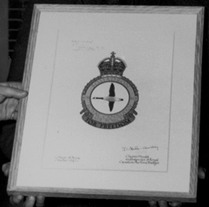
Oct 42 Due almost entirely to the initiative and persistence of W/C Timmerman, the squadron badge, with the Canada goose as the centerpiece and “FOR FREEDOM” as the motto, was approved by King George VI.
1 Jan 43 With headquarters at Linton-on-Ouse, Yorkshire, the newly formed 6 (RCAF) Bomber Group is declared operational. 408, initially equipped with the Halifax (and later with the Avro Lancaster), are one of nine squadrons then under the control of 6 Group. The Commanding Officer: W/C W.D.S. ‘Tiny’ FERRIS.
24 Jul 43 The ‘Battle of Hamburg’ begins. As part of four separate, massive raids on that city, 408 sent 53 Halifax II aircraft. One was lost.
18 Nov 43 The first Bomber Command sortie in what was to become known as the ‘Battle of Berlin’. By its end, on 31 Mar 44, the city would be visited sixteen times. Having flown on eleven of these missions, F/Sgt J. Douglas HARVEY was later cited as the 408 Squadron pilot with the most trips to Berlin – and was presented with a gold wristwatch to mark the achievement.
22 Nov 43 During the ‘Battle of Berlin’, a Lanc II flown by P/O BRAGER completed the squadron’s 2,000th operational sortie. A month later, Brager and his crew are lost over Frankfurt.
30 Mar 44 The end of the ‘Battle of Berlin’ period, with 408 having suffered the loss of 27 aircraft and crews – more than the full strength complement of any bomber squadron in 6 Group. On the same date, during an attack on Nuremburg, Bomber Command suffered its worst losses of the war when, out of the 782 aircraft dispatched a total of 95 aircraft and their crews failed to return. 6 Group lost 14 of the 118 aircraft it contributed – a loss rate of almost 12%, more than twice that normally expected on operations at that time. 408 Squadron itself lost one of the twelve aircraft it had dispatched to Nuremburg.
5 Jun 44 In support of the imminent invasion of France, 408 Lancasters attack the coastal battery at Longues. The following morning, D-Day, 408 breaks all previous records to put 21 aircraft into the air to attack the bridge at Coutances, France – a key crossing for the Germans, who are trying to bring up reserves in an attempt to repel the Allied invasion forces.
24 Jul 44 A raid on Stuttgart, flown by F/O R.A. CLOTHIER and his crew, marked the squadron’s 3,000th operational sortie. Just 5 ½ months later, F/O D.M. WYLIE logged 408’s 4,000th trip, striking Saarbrucken on 13 Jan 45.
26 Jul 44 Invasion support continues. For a raid on Hamburg, 6 Group send 239 aircraft. 22 are lost including 4 from 408.
13 Oct 44 In a rapid change of commanding officers, W/C A.R. MCLERNON is screened, is succeeded by W/C J.F. EASTON, who himself is screened five weeks later, and is followed by W/C F.R. SHARP, who turns out to be the squadron’s last wartime commander.
14 Oct 44 A superb effort on the part of the squadron groundcrews and aircrews alike enabled 17 aircraft to bomb Duisberg in daylight and 18 crews to bomb the same target that night – with no casualties. Amazing!
25 Apr 45 F/L G.H. GROSS and his crew record the squadron’s last operational sortie of the war: Number 4,610.
8 May 45 V.E. Day, 408 is promptly selected as one of the squadrons to join the ‘Tiger Force’ fighting against Japan in the Far East. Before their training and re-equipping to the Lancaster X is completed, American use of atomic weapons on Hiroshima and Nagasaki bring a speedy end of the war.
5 Sep 45 408 is officially disbanded. During its time on operations from 1941 to 1945, the squadron:
· Had flown 4, 610 sorties
· Dropped 11, 340 tons of bombs and mines
· Lost 170 aircraft, both in training and on operations
· 933 personnel were killed, missing or prisoners of war
· 200 decorations were won by squadron members, including 160 DFCs and 30 DFMs
· Eleven Battle Honours were awarded for its wartime operations
Hello I’m researching the following crew members of 408 Squadron Lancaster DS788 EQ-C 20-02-44 KROPESWOLDE
F/O J.A. Frampton – pilot
Sgt. K. Smith – gunner
Sgt K.H. Benet – gunner
F/S J.J. Astles – navigator
I am assisting a Dutch National who has adopted all of their graves and he would like to know as much about them as possible as well as getting in contact with any of their living relatives. Thanks in advance ! Monica Hobbs
Did you get a reply from your inquiry?
Hello Monica,
Don’t know if you are still on this, but I know the niece of F/O Frampton. She is interested in following up on this. Her mother, who would be Frampton’s sister is still alive, and has just turned 100.
We live in Victoria BC
I am currently a retired engineer, working on the restoration of Lancaster FM 104 at the BC Aviation Museum, so very interested in RCAF WW 2 history.
Ted Syme
The other members on that crew was KW Tindall. You can search them
all up over here https://www.veterans.gc.ca/eng/remembrance
/memorials/canadian-virtual-war-memorial
https://caspir.warplane.com/personnel/unit-search/p/600006688 for all details
Hello,
I am researching Louis J Reaume from Windsor Ontario. He was my mother’s first cousin. He died Nov. 02, 1944 and is buried Leopoldsburg War Cemetery in Belgium. I believe he was Squadron 408 plane letters EQ-X. He is buried with three other crew: A.C. Ineson, V.B. Gilson, and D.A. Staples. I believe they were originally buried at the Fosse American Cemetery and moved in 1946 to Leopoldsburg.
I’m wondering: 1. What happen to rest of the crew? 2. Where were they bombing when they went done?
Hello Paula,
According to the logbook of 408 sqn. The Plane that Louis J was on was on a bombing mission over Dusseldorf (GER), their plane was hit (prob. Flak) and crash-landed in Belgium. Unfortunately, 4 members died that night including your relative, the others were injured and were taking care of by the #50th American field hospital, behind friendly lines.
The plane marking was NP 744 “X”
I hope it answers a few of your question,
Sincerly
Pierre.
Hi Paula,
I just saw your query and have the following information for you. Halifax VII bomber, s/n NP744, EQ-X, took off from Linton-on-Ouse at 1618 hours on Nov 2, 1944. They crashed behind enemy lines at approx. 2212 hrs on a mission to Dusseldorf. The four crew members you named are indeed buried at Leopoldsburg War Cemetery, However, the other three crew members were injured but survived and were admitted to US Army 50th Field Hospital. They were Sgt. A. Anderson, P/O D H Woodworth RCAF and F/Sgt W G Sutton RCAF. Hope this helps!
Hi. I’ve started doing a good amount of research into my Great Uncle’s service in the RCAF during the Second World War and am looking for some help if possible. His name was Charles Percy Miller (but went by Chad). Service # R/156897. He was a Mid-upper Gunner in Avro Lancaster II DS774 EQ-F when the plane was shot down returning from a night raid over Dusseldorf, Germany on the night of Nov. 3rd/4th, 1943. The plane crashed into the sea off the coast of Holland where Chad, along with two other crew members (Navigator Tom William Hilliard & Air Gunner Colin Murray MacDonald) were able to get into a life raft but were found dead when it washed ashore. I was wondering if anyone has any information on this flight crew or the Lancaster they flew (name, photos, ect.)? Prior to flying this Lancaster, they flew Halifax bomber JD333.
Thanks,
Myles Duncan
Dear Myles, I have visited Crooswijk cemetery yesterday and made pictures for my Instagram page @reme.mber1940.1945 I will post these next Thursday, please feel free to contact me. Best regards Arjan van Prooijen
Hi, I am looking for the composition of one 418 Sqn crew in 1945.
One of the members would be
R181695 W/O. Frederick George “Fred” Ursel , Navigator. One of his aircraft would have been the Lancaster “Vicky- The Vicious Virgin” believed Lancaster X KB905 EQ-V.
When Ursel may have been posted there? Tried to trace him in the ORBs, unfortunately only the pilot’s name is recorded in 408 Sqn ORBs.
My late uncle, Hilliard Dean, was one of the ground crew servicing EQ-V, Vicky the Vicious Virgin. At Linton-on-Ouse, Yorkshire. He referred to it as ‘his’ plane, and he and others in his crew serviced it until the end of the war. He was from Locust Hill, Ontario, near Markham.
JUST ,KNOW THAT “VICKY VICIOUS VIRGIN” WAS IN 408 Squadron, SAME AS MY PLANE “U – UNCLE I think I might still have pic of same. Based at Linton on ouse. I was tail gunner in those days. Had Halfaxes and changed to Lancs for last 7 ops, and flew them home to Greenwood NS for Japan ops. Not sure but my buddy Frank ( Slim ) Herring may have been in Vicky crew. He joined RCMP after discharge. memory is a little shaky these days. 95 yrs. back then was 19
WELCOME ANY AND ALL COMMENTS.
MR. Hardwick…Thank you for your response to my information about my Uncle, Hilliard Dean, of 408 Sqn, and his time at Linton-on-Ouse servicing Halifax PN230/EQ-V, “Vicky The Vicious Virgin”. I’m very slow in responding to you, and I apologize! Do you know if there is a book, or any publication, that lists all the 408 Sqn members during those years at Linton-on-Ouse? I am also looking for pictures of “Vicky The Vicious Virgin”, her crew, and any other information about the Squadron.
I’m looking to research my great uncle
Wo2 William Edward Raban who was shot down and killed on the 30th of December 1943 his Lancaster was DS718
Thank you so much for your service! My uncle was Pilot Officer on Halifax EQ-E shot down on 29.1.45. I’m wondering if his aircraft had a nick name.
Hi all, my name is Jeff Farrrow and my dad Phil Farrow was a 408 pilot flying Hampdens. He was a New Zealander, and part of the Commonwealth training programme being trained in Canada then transferred directly to 408 Sqd. Del Badiuk was a great help to me with copies of his flights etc. My dad has passed on now but I have a few mementos and a wonderful 408 Sqd plaque made for me by the present Sqd workshop. It sits over my office desk along with his Medals. I have had great pleasure reading all the correspondence on here and will follow up regularly.
I am adding my email address in case anyone wishes to contact me.
Did he have a nickname? I have a picture that my Dad took on V Day with a lot of signatures on a huge blackboard
I just found this site while preparing for Remembrance Day Service at the school where I work, and am amazed at the information people have.. My father, Frank Lawson, was a tail and mid upper gunner with Goose Squadron, in the Lancaster. I do not know his crew number but have some information. When the Lancaster toured Canada a few years ago, one of the tour guides helped interpret my dad’s flying log for me. I wish now I had written down what he told me, as my dad wrote only the facts and never talked about the war. If anyone recognizes dad’s name or has information, I would appreciate it. I do know his pilot’s name, I think, was Ted Vaughn.
Denise Lawson
Served as ground crew with 408 Squadron in the UK, late November 1941, early December 1944. The Lancaster phase was at Linton-on -Ouse Yorkshire August 43/December 44.
Unfortunately it’s more difficult to find information on aircrew surviving the war since access to their personal files is restricted while the personal files of aircrew Killed In Action are archived and available for research in the Canadian Library in Ottawa.
The following address is quite lengthy so I highlighted it and pasted it into my browser.
http://www.bac-lac.gc.ca/eng/discover/military-heritage/Pages/obtain-copies-military-service-files.aspx
Suggest you request a genealogy package for your father and also apply for his military records.
Your father’s Log Book records his 408 Squadron flights, both training and Operations, the name of Pilot, duration of flight, etc.
Hope you will find this helpful.
George R McKillop
New Westminster, BC
Email: george_mck@shaw.ca
My uncle, Alex Campbell, is the last living Lancaster pilot and sharp as a whip. He was with RAF Squadron 514 before his bomber was shot down over France. There’s a newspaper article about him called ‘The Lancaster Love Story’ on http://www.brantnews.com and also a YouTube video with the title July 28 1944, a Lancaster Interview with him in the pilot seat of one of the only 2 remaining Lancasters in the Hamilton Warplane Heritage Museum. He may have met your father. Contact me and I will give you his email address.
Cory
Your uncle, Alex Campbell, is not the last living pilot who flew Lancasters during WWII, he has distinguished company. Pilot Officer Pilot, Wallace George Phillips DFC of Chambly Quebec finished his Tour of Operations on 408 Squadron Lancaster Mark II EQ-F in the summer of 1944.
The following quote from his son Geoff’s letter of May 8, 2015 reports that: his Dad’s doing ok, but his vision and mobility have decreased slowly since our trip to Linton-on-Ouse in 2013. His sense of humour is still there, though. He looks forward to leaving St Anne’s for the summer and returning to his home where we will walk by the Chambly Basin, the river and have a tea at Tim’s.
George R McKillop
New Westminster, BC
My grandfather Alvin bossenberry was 408 goose squadron I’m looking for more info maybe photos?
Daniel,
My mother, Judith, is Alvin Bossenberry’s oldest daughter. She and her sisters still have much of his WWII memoribilia.
Contact me at email below & I will share with you anything I can.
Just finding this site today. My uncle Thomas Roland Mellish was a pilot of a Halifax bomber shot down over Germany in 1943. I wonder if you knew of him or had any contact with him? Thank you.
Thomas
Served with 408 Squadron as ground crew in the UK late November 1941-early December1944. Have updated the Squadrons Wartime Casualty List and researched numerous air crews.
W R Chorley Bomber Command losses of WWII Volume 4, 1943. Operation Gelsenkirchen,
408 RCAF Squadron aircraft EQ-H crashed at Essen-Kupferdreh
Thomas Roland Mellish, Flying Officer Pilot, J/14320, RCAF, KIA 10 July 1943
Sergeant Plewman W H, Navigator, RCAF, POW 10 July 1943
Flying Officer Crouch E, Air Bomber, RAF, KIA 10 July 1943
Warrant Officer1 Pixley A N, Wireless Operator Air Gunner, RCAF, POW 10 July 1943 Death 18/04/1945
Flight Sergeant Prentice W R, Air Gunner, RCAF, KIA 10 July 1943
Sergeant Willis W G, Air Gunner, RCAF, POW 10 July 1943
Sergeant Pickering G S, Flight Engineer, RAF, POW 10 July 1943
Have additional information re burial and POW camps. If you are interested respond to this posting.
Regards
George R McKillop
New Westminister, BC
I am researching Asa N Pixley (my great Uncle). He was a POW at Stalag 357 after being shot down over Germany. The official version of his death was peritonitis, however, a man who was with him on the forced march out of the camp, claimed that he was bayoneted because he was ill and could not keep up. I would certainly be interested any any info you may have. My mother still speaks of him, and remembers well the day he left for war.
Thomas Roland Mellish was my wife’s grandfather. We know he is buried in Germany but do not know where. Can you help with this. We would also like to know if you new him.
Thank You,
Chuck Klacko
Gainesville, Florida
My father was a pilot with 408 , Tom Kaye, and I have his log books, there is a Sgt Mellish as one of his crew on several flights in April 1942, flying out of #16 O.T.U Upper Heyford. Unfortunately that is the only time I see his name mentioned, regards, Debbie Elliott
Chuck….
Follow attached link. Good information there.
https://www.veterans.gc.ca/eng/remembrance/memorials/canadian-virtual-war-memorial/detail/2040328?Thomas%20Roland%20Mellish
Relative of WG Willis here. I know it’s been a longtime since this post but would love to have info regarding POW camp Wilfred was in.
George, Thomas Mellish was my uncle. Years ago, my father visited Sergeant Pickering, but my father referred to him as John. Do you know Pickering’s full name and if went by the nickname John?
Hallo Thomas,
mein Name ist Andre und ich bin ein Forscher aus Deutschland.
Ich wohne 10 Kilometer entfernt von dem Ort wo dein Onkel mit seiner Halifax EQ-H abgestürzt ist.
Im letzten Jahr habe ich Wrack Teile eines Halifax Bombers auf dem Grundstück eines Freundes gefunden das sehr nahe an dem Absturzort liegt. Ich würde vermuten das es die Halifax deines Onkels ist.
In diesem Jahr wird es eine Prospektion dort geben.
Ich halte Dich auf dem laufenden
Viele Grüße
Andre
Sorry here in English 🙂
Hello Thomas,
my name is Andre and I am a researcher from Germany.
I live 10 kilometers away from where your uncle crashed his Halifax EQ-H.
Last year, I found wreckage of parts of a Halifax bomber on a friend’s property that is very close to the crash site. I’d guess it’s your uncle’s Halifax.
There will be a prospecting there this year.
I keep you updated
Best regards
Andre
Hi Andre,
I’m the granddaughter of Thomas Rolanda Mellish. I would very happy to know about the crash and the pieces found. His two daughter’s is still alive and so is his wife who just turned 100 years old.
Thank You
Deena Erickson
Hi Deena,
My grandfather (Jim Innes) was also in that squad and I have a letter he wrote to his parents about your grandfather when he was killed. If you give me your email, I can send it to you.
Hello Jill,
Thomas Roland Mellish was my uncle; Deena is my cousin. I’d love a copy of that letter, too, if it’s no trouble.
Thank you,
Sandra (Mellish) Fram
Andre.
Thank you for sharing that information. I would very much like to know the results of your excavations.
Thank you
Hello Andre, do you have any information on what came of that search of the plane wreckage in 2018?
My great uncle Eric Crouch was a crewmate of Thomas Mellish and was killed during the same mission. I visited his grave at Reichswald Cemetary near Essen in Germany. They are buried side by side, along with William Prentice. It was a really humbling experience to pay our respects for their sacrifice.
Hi Paul.
It’s been a while since your post and I just stumbled across it while researching the men who graduated from Air Bombers course 62, at Malton in Canada in December ’42. One of those was my grandpa, William Lamb, and another was Eric Crouch.
I have some photos from that course and your great uncle will be included in them. Of course, I’m happy to send them across if you’d like them, so please just drop me an email to jake1jacobs@hotmail.com if so.
I’m trying to identify who’s who in the photos and Eric Crouch is someone who I’ve so far been unable to put a face to his name.
Thanks,
Simon
My father, Robert Scott MacQuarrie, PEI, was an RCAF aero mechanic at Linton-on-Ouse. I am just now researching that base and seeing the post above pequed my interest. I have copies of his discharge papers and a few other relevant docs. In the mid ’80’s a fellow airman from BC looked him up in NB where he was then living; unfortunately they did not connect and I don’t have the name but always wondered if that guy has family who ever heard stories about “The Goose Squadron” He passed away in 1989.
Denise –
It’s been 9 years since you posted this, but I stumbled across this post while doing a project interviewing WWII vets in Victoria, BC for a video honouring our veterans for Canada 150.
Ted Vaughan is alive and very well and living at Veterans Memorial Lodge at Broadmead, in Victoria. He remembers all his flight crew, and I believe he mentioned your Dad was a hard rock miner from Flin Flon, and one of the “old men” – at 28.
Your Dad is in some of Ted’s pictures, which are posted here:
http://www.canadianletters.ca/collections/all/collection/20858/doc/223
Bruce Meikle, Victoria
email: bruce@suburbiastudios.com
THE MYSTERY OF THE AIRCRAFT GENERATOR
My dad owns what is believed to be an aircraft generator belonging to a plane which crashed on the site of the railway station of his hometown in Eastern France, in the occupied zone. He was 4 when the incident happened and the object ended up with his family who lived near the station at the time.
Wouldn’t it be fascinating to know which aircraft it belonged to and who was flying it, did the crew died? Would they be any survivor still alive?
This is what we’ve got from the local archives:
“On July 16th 1943 around 1am, the railway station in Besançon, Doubs is bombed.
Halifax bombers left bases in Yorkshire in the night of the 15th July with the bombing of the Peugeot factories of Sochaux-Montbeliard as a primary target (with controvertial results – only 1.7% of the bombs felt on target, so 35 out of 700), a number of aircrafts (between 8 and 12) also attacked the Besançon railway station as a secondary target according to Bomber Command’s report.
108 bombs were dropped, 84 impacts were recorded on a surface of 1km2. The station was destoryed at 100%, however, it was partially repaired, and from the 18th July, Germans were able to restore train service to Germany.
According to records, 2 aircrafts crashed that night, a Handley Page Halifax belonging to the Canadian squadron (there is doubt whether it was a bomber as such or a pathfinder whose mission was to mark the target) and a Dornier DO217 belonging to the Nachtjag Geschwader based in Dijon or Dole. The German aircraft, badly damaged would have collided with the bomber.
The events which happened that night are nevertheless vague and can’t be verified. It is therefore possible that the generator belongs to one of those 2 aircrafts.”
Would any of you know where I could find any information, if following the RAF route? It would be a lot easier than the German one. Who would it be best to ask for identify the object which appears to have no markings or serial number? Thanks in advance for your help and advice.
I have bought an Airfix model kit of an Avro Lancaster BII & one of the options is Z Zombie LL725, in July !944. I am going to make a diorama base for it, as she will be wheels down & i intend to have a bombing up crew infront of Z Zombie. Can anyone tell me the fate of this aircraft & who flew her & crew names, please. this is my memorial to the crew.
Mark Drinkall. July 9, 2014 at 6:41 am
I have bought an Airfix model kit of an Avro Lancaster BII & one of the options is Z Zombie LL725, in July !944. I am going to make a diorama base for it, as she will be wheels down & I intend to have a bombing up crew in front of Z Zombie. Can anyone tell me the fate of this aircraft & who flew her & crew names, please. this is my memorial to the crew.
Mark
Served as ground crew with 408 Squadron in England late November 1941- late November 1944. 408 Squadron aircrews were pleased with the change from the Halifax to the Lancaster II and
I have fond recollections of the W G Phillips and A Quinlan Crews and the groundcrew on our Lancaster Mk II, LL633 EQ-F.
It would be a easier to talk about this but here’s my recollections and/or explanation:
You have bought an Airfix model kit of an Avro Lancaster II. One of the options is Z Zombie LL725, in July 1944.
No indication of date in July
Any other 408 squadron options?
You are going to make a three dimensional base with wheels down and a bombing up crew in front of Z Zombie.
Believe RCAF Trade for “bombing up crew” is Armourer and think you must have seen photo (PL29074) “408 Squadron Mark II Avro Lancaster LL725 EQ-Z is refuelled and re-armed during quick turn-around”.
Can anyone tell you the fate of this aircraft, who flew her and crew names, please.
The process of selecting crews for Operations and their assigned aircraft is an example of something that’s easier to discuss than describe in writing. Crew names for a date in July 1944
is possible but time consuming. Our active RCAF Webmaster/Administrator is on assignment and he’s the only one that can check 408 Squadron Operational Record Books for July 1944.
Our ability to researching crew names for all LL725, EQ-Z Operations between August 1943 and May 1945 is virtually impossible. Therefore suggest the names of the crew for July ? 1944 and
an all crews memorial.
Checked my updated 408 Squadron Wartime Casualty List 1944-45 and Lancaster II LL725,
EQ-Z survived WWII.
Do you have a copy of, or access to, 408 Squadron history?
408 Squadron History book, ISBN 0-920002-32-3. Copyright 1984. The Hangar Bookshelf.
Page 20, Photo of 408 Squadron Nose Art, Halifax “Z” Zombie – “ a pair of 408 Squadron members prepare the nose of a Halifax for the paint brush.” Note: This was at Leeming Yorkshire, the Nose Art was elaborate with twenty (20) Operation Mission Markings completed between January 9th 1943 and August 8th 1944.
-1-
Page 35, Photo (PL29074) 408 Squadron Mark II Avro Lancaster LL725 EQ-Z is refuelled and re-armed during quick turn-around. At Linton-on-Ouse Yorkshire the Nose Art is not as elaborate Operation/Mission Markings 2 (swastikas) claiming two enemy aircraft shot down, 5 bombs for raids on Germany; and 7 maple leaves for attacks on targets in enemy held territory.
D Day, June 6th and the summer of 1944 were trying but exciting times. 408 Squadron broke all previous daily records putting 21 aircraft in the air to attack the bridge at Constance France as the Germans were trying to bring up reserves.
408 Squadron continued to operate it’s Lanc II’s until the second Halifax conversion phase was completed.
Hope you find this helpful.
George R McKillop
New Westminster BC.
July 28, 2014
George: It is Remembrance Day and I am once more looking through some of my Dad’s wartime kit — decorations, flight logs, etc. My father was S.William McGill, from Toronto. He was am air navigator on a “gen” crew with the 408 Squadron (“Bargeman”) flying out of Linton-on-Ouse (“Dog Bark”)from late 1944 to VE Day. He completed 23 Ops, including the final 408 op of WWII on 25/4/45 over Wangerooge. All 25 ops were with F/L Gross as pilot. And all ops were in Halifax EQ-Z, “Z for Zombie”. The signatures at the back of Dad’s Flying Log Book include: W.O.Gross (Skip)Vancouver; Pete Nygard (MU)Vancouver; Don Mann (BA) Hamilton; Reg Burr (WOP) Ioco; J.Anderson (ENG) Hamilton; N.H.English (?) Campbellton NB; E.McLeish (TG) Hamilton; Bob Lanalts (?) Calgary; Bill McGill (nav) Toronto.
R
George: It is Remembrance Day and I am once more looking through some of my Dad’s wartime kit — decorations, flight logs, etc. My father was S.William McGill, from Toronto. He was am air navigator on a “gen” crew with the 408 Squadron (“Bargeman”) flying out of Linton-on-Ouse (“Dog Bark”)from late 1944 to VE Day. He completed 23 Ops, including the final 408 op of WWII on 25/4/45 over Wangerooge. All 25 ops were with F/L Gross as pilot. And all ops were in Halifax EQ-Z, “Z for Zombie”. The signatures at the back of Dad’s Flying Log Book include: W.O.Gross (Skip)Vancouver; Pete Nygard (MU)Vancouver; Don Mann (BA) Hamilton; Reg Burr (WOP) Ioco; J.Anderson (ENG) Hamilton; N.H.English (?) Campbellton NB; E.McLeish (TG) Hamilton; Bob Lanalts (?) Calgary; Bill McGill (nav) Toronto.
Regarding the Lancaster — on 20/5/45 Z-Zombie transferred to Lanc X, and from May 2oth 1945 to June 12th, 1945 completed eight test flights. On 14 June 1945 z-zombie (Lanc x) departed Base for home — Base– St.Mawgans — Lagens (Azores) — Gander — arriving 17/6/45 at Scoudouc “Home at last By God”.
My father passed away in 2005. I can count on the fingers of one hand the number of times he mentioned the War. He was only 21 at the time of his first op over occupied Europe. His flight log carries the names of his fellow airmen who never returned, but were simply “gone”.
I hope this information is helpful to you. Please let me know if there is anything more I can provide.
best
Jamie McGill
Hi Jamie,
My name is Donald Mann. I am Donald Mann’s grandson. I am looking to see if I may be able to get in contact with you and discuss any information you might have on my grandfather? Or pictures and such. Reading what you wrote brought a tear to my eye to know our fathers or fathers fathers are not forgotten about. Cheers.
My namesake, Ronald Ward Smith was 408 Squadron. He had been an ornithologist at Queens University, Kingston prior to enlisting. He was a Pilot Officer who returned from a bombing raid over Astrop, Rauxel, Germany on September 11, 1944 but due to his severe injuries and several of his crew had been killed, crash landed at Linton, Yorkshire, England. He is buried at Stonefall Cemetery, Harrowgate, Yorkshire, England
He is my mother’s brother and I have recently found a cache of letters, documents, etc.
You mention a book “408 Squadron History “ Where would it be available??
Thanks for your help
Hi Mark,
I just came across your note. My dad, Terence (Terry) Delaney, served in the 408 Squadron @ Linton on Ouse from January-June,1944. He & his crew flew in their beloved Lancaster bomber, named the Zombie. I don’t know if this would be the same as the Z Zombie you’ve mentioned. My brother in law Paul created a model of this plane for our dad years ago. I have it proudly displayed now, as my dad passed away in 2013. I remember Paul telling me he had to use 2 different model kits to reproduce it exactly. He also did a beautiful job of painting the tiny “Zombie” nose art.
I can find out some or maybe even all of the names of the crew. Sadly, I know plane went down with a new crew after dad and his crew were finished their tour. My dad wrote many notes and stories from those days and thankfully shared his experiences. I have quite alot of information, the letters he wrote my mom, pictures and even a lengthy interview of my dad on CD. He also is featured on the Memory Project site if you’d like to hear him share a memory.
I believe my father Preston Weir (from Lake Cowichan, BC) was a member of the ground crew with the 408 Squadron, Bomber Command during WW II. One of the places he was stationed to was Granby in the UK. I wonder if you can confirm and give me any information about his military history. He passed away in December, 1991, and never spoke about his wartime experiences when we asked what he did during the war, but he did sit us down in front of the TV when the Dambusters movie came on and said that was where he was stationed. I would appreciate any information I can get as I am now the ‘keeper of the family history’
Hi Barbara
I know that 408 was not stationed at Granby as a squadron but I do believe some of the unit was transferred to assist the dam busters. I had another gentlemen whose father told him the same thing. There is a gentleman that I talk to who is in Vancouver area and he was also ground crew with 408 during the war . I am going to pass your info to him and see if he knows anything. His name is George McKillop. As an immediate relative of your father you can request his wartime records from archives in Ottawa. The website is http://www.collectionscanada.gc.ca/022/022-909.007-e.html
Sorry, my mistake, it was Gransden Lodge Dad was stationed at. After reading more, now I’m not sure if it was the 405 or 408 squadrons, and unfortunately Mom has dementia and can no longer tell me any of the details.
Barbara Fogarty
July 2, 2014 at 12:55 pm
“Sorry, my mistake, it was Gransden Lodge Dad was stationed at. After reading more, I’m not sure if it was 405 or 408 squadron…..”.
I believe my father Preston Weir (from Lake Cowichan, BC) was a member of the ground
crew with the 408 Squadron, Bomber Command during WW II. One of the places he was
stationed to was Granby ……….
No apology asked, none required.
Gransden Lodge Airfield is a former wartime airfield located 10.1 mi (16.3 km west of Cambridge, Cambridgeshire England. Gransden Lodge opened in April 1942 as an operational RAF Bomber Command station called RAF Gransden Lodge with three concrete runways. At the end of 1945 the airfield was transferred to Transport Command but the last operational squadron was disbanded in February 1946 and the RAF station closed in 1955.
405 RCAF Squadron, 19April 1943 – 26 May 1945
Aircraft Handley Page Halifax and Avro Lancaster
May 26th 1945 to Linton-on-Ouse Yorkshire. En route to Canada in preparation for Tiger Force Operations. 408 Squadron History Book Copyright 1984 the Hangar Bookshelf ISBN 0-920002-32-3. Return to Canada, page 37 “On June 14th the trans-Atlantic journey to Canada via the Azores began and several days later it was completed without incident.”
Believe 405 Squadron left on June 17th 1945.
George R McKillop
Your Posting of June 18th and Association Response Association suggested I may be able to help you research your father’s military service. Served as ground crew with 408 Squadron in the UK from late November 1941 until November 1944. However it’s virtually impossible to decide upon an approach and where to begin without more information on your fathers service in the
R CAF prior to 1942/43.
You believe your father Preston Weir (from Lake Cowichan, BC) was a member of ground crew with the 408 Squadron, Bomber Command during WW II. One of the places he was stationed was Granby in the UK” and when the Dam Buster movie came on we asked what he did during the war and he said that was where he was stationed.
The village of Granby is in the County of Nottinghamshire close to the border of Leicestershire County near Melton Mobray and not far from where 408 Squadron was based at RAF Stations Syerston and Balderton. The airfield at Granby is not identified as an RAF Airfield but appears to have been used by the United States and Canada for parachute training.
617 Squadron, RAF Station Coningsby Lincolnshire
http://www.raf.mod.uk/rafconingsby
Opened as a bomber base in 1940 and continued in this role for the rest of the war. RAF, 617 Squadron was based at Coningsby during 1943 and 1944 and bombed the Eider Dam.
Note:
On May 15th 1943 408 Squadron was based in Yorkshire not Nottinghamshire.
Granby , 408 Squadron, RAF Stations Syerston, and Balderton Nottinghamshire
Granby Nottinghamshire
http://en.wikipedia.org/wiki/Granby%2C_Nottinghamshire
408 Squadron RAF Station Syerston Nottinghamshire
July 20th – December 8th 1941.
http://en.wikipedia.org/wiki/RAF_Syerston
408 Squadron RAF Station Balderton Nottinghamshire
December 9th – September 12th 1942
http://en.wikipedia.org/wiki/RAF_Balderton
408 Squadron RAF Station Leeming Yorkshire
Leeming, September 13th 1942 – August 26th 1943
http://en.wikipedia.org/wiki/RAF_Leeming
408 Squadron RAF Station Linton-on-Ouse Yorkshire
Linton-on-Ouse, August 26th 1943 – June 13th 1945
http://en.wikipedia.org/wiki/RAF_Linton-on-Ouse
As an immediate relative, you can request your father’s wartime records from Ottawa. The website is:
http://www.collectionscanada.gc.ca/022/022-909.007-e.htm/
July 4, 2014
I am looking for information of Cyrus Garfield Kelly who was a member of 408 Goose Squadron. I have the understanding he was a Flt. Sgt and that he may have been the Squadron’s Disciplinarian and was also know for Recreational Activities or Officer. I am not exactly what his role was in the Squadron. If anyone knows of him or his role in the squadron I would be most appreciative. Thank you for your time and efforts.
Sincerely, Mary Halbert
Granddaughter of Cyrus Garfield Kelly
The following article appeared in “The Kingsville Reporter”, Kingsville, Ontario, Thursday, September 17, 1953, p. 1:
(Note: A ? indicates I was unable to decipher a letter/word.)
Garfield Kelly Mentioned in English Newspaper
In a clipping from the newspaper “Hangar Log” in England, a former Kingsville resident, Garfield Kelly, was mentioned as follows:
“F.S. C.G. “Gar” Kelly, our new assistant ?.W.O., hails from Tilsbury, Ont. Born there July 30, 1920, and schooled at Public and High Schools in Kingsville, Gar must have loved school as he still thinks of Kingsville as home. After finishing school Gar took up the trucking business, then joined the R.C.A.F. shortly after the outbreak of World War II. Served overseas with his home town squadron No. 408 (Bomber); 412 (Coastal) squadron and 415 (Fighter) squadron. Finished up his three-year overseas tour as W.O. 1 1/e Reception Wing, 3.P.R.C., Bournemouth, and was repatriated in November 1944.
Gar is not an R.A. spec for “nowt”. He caught junior and senior softball in the Air Force and was half the batting of the R.C.A.F. ?? (U.K.) champions in 1944. His team Stn. Trenton won the Eastern Ontario Baseball Intermediate “B” championship in 1948. Softball and baseball catcher on Stn. Clinton championship teams. Also Gar’s no slouch at hockey and football.
F.S. Kelly is married and has two daughters, Mary 6, Wendy 3, and a son Garfield Jr., aged 1 year.”
My father was Allan N. Stock. RCAF 408 squadron WW2. He was a navigator with Mcleod I believe. He flew the Lancaster. He passed away February 2007.
We have photos, medals etc but could you please fill in his story for me?
Thank-you
Correction: Allan Stock passed away January 2007
Dear Sir,
I am researching the Kassel bombing of 27/28 August 1942. One of the things I am trying to find out is which squadrons provided aircraft for the attacking force and how many. 408 Squadron also took part in this raid. Can you tell me how many of the squadrons aircraft were involved and perhaps even tell me which aircraft?
I am looking forward to your reply.
Yours Sincerely,
Pieter Schlebaum
The Netherlands
Pieter Schlebaum The Netherlands
February 18, 2014 at 12:41 pm
Dear Sir,
I am researching the Kassel bombing of 27/28 August 1942. One of the things I am trying to find out is which squadrons provided aircraft for the attacking force and how many.
This information you are seeking is in Volume 3 of W R Chorleys Bomber Command losses of the Second World War. A summary of Bomber Commands participation is located at the beginning of each Operation i.e. the first page of Operation Kassel, August 28th 1942. The following pages lists all Operational aircraft and crew losses by date, squadron, aircraft identification, names of all crew members (regardless of Service or Nationality) and what happened.
408 Squadron also took part in this raid. Can you tell me how many of the squadrons aircraft were involved and perhaps even tell me which aircraft?
Unable to provide the number of 408 aircraft involved but the Squadron lost one aircraft, Hampden P1244, EQ-Y. Aircrew, Flight Sergeant Pilot Jennings AH, Warrant Officer Navigator Chaston L G, Sergeant Wireless Air Gunner Thompson C H and Flight Sergeant Wireless Air Gunner Todd J W.
Pieter will provide additional personal information by Email. if required.
George R McKillop
New Westminster, BC
Canada
Email: george_mck@shaw.ca
Hi Pieter, George,
My Uncle Len – Lionel Greer Chaston, was the navigator on the flight that George identified. He was shot down and killed. I am trying to find out anything I can about his flying history. Or anything else about his time in the 408th. My Dad (his brother) visited his grave site in Hanover. I have all of his medals, and pictures of him. Also his wings that he earned in Saskatchewan. Any info would be greatly appreciated. I know it was his 27th mission. If he had completed 30 he would have been sent home. Apparently his death devastated my Grandparents. They were never the same afterwards, is what my Mom and Dad said.
Thanks,
Len Chaston
Hi Len My name is Pete Stevens and I am part of the RAF Balderton Reseach Group and was hoping that you would be able to let us have a Photo of you Uncle Lional as we now have a permanent display at Newark Air Museum and we are trying to gather as many photo’s of air crew and ground crew for this display. We are also hosting an RAF Balderton Reunion on the 8th April 2018 at the Museum for all surviving airmen and women who served at Balderton and also relatives of those who served at RAF Balderton. There will be a ceremonial planting of a commemorative tree and the laying of a piece of RAF Baderton’s runway with a plaque dedicated to all those who severed there
Kind regards Pete
My father was “Bob” Robert William Mann, born Brandon, Manitoba Canada, December 31, 1920, served as LAC Mechanic ground crew with 405 pathfinders and 408 Goose Sqdn.
He passed away Dec. 27, 2013, in Guelph, Ontario, Canada.
I have been trying to find more information about his service and family roots in the UK on “Ancestry.com”, to no avail.
He was the son of Harry James Mann, WWI British Military Bandsman and stretcher bearer, born in Bath, UK, who moved to Brandon, Manitoba, Canada and later settled in Hanover, Ontario, where my father was living when he volunteered for the RCAF.
My father’s father had a twin brother and I understand that his nephew was also a military bandsman and prison guard in the UK.
Any information anyone might have about my father’s service record or his surviving extended family members (MANN) in the UK would be appreciated immensely.
I forgot to mention that my father was also an accomplished musician (Alto Sax. and Clarinet) and likely performed with the Sqdn. band if there was one.
Kevin Mann – February 5, 2014 at 6:15 pm
My father was “Bob” Robert William Mann, born Brandon, Manitoba Canada, December 31, 1920, served as LAC Mechanic ground crew with 405 path finders and 408 Goose Sqdn. He passed away Dec. 27, 2013, in Guelph, Ontario, Canada.
I have been trying to find more information about his service and family roots in the UK on “Ancestry.com”, to no avail. He was the son of Harry James Mann, WWI British Military Bandsman and stretcher bearer, born in Bath, UK, who moved to Brandon, Manitoba, Canada and later settled in Hanover, Ontario, where my father was living when he volunteered for the RCAF.
The birth of your paternal grandfather may be registered in Quarterly
Registrations of Birth as follows, “Births, June 1881, Mann Harry James,
Cosford District, Volume 4a, Page 587″. The district of Cosford is in the
County of Suffolk.
See Free Births Marriages and Deaths
http://freebmd.rootsweb.com/
Any information anyone might have about my father’s service record or his surviving extended family members (MANN) in the UK would be appreciated immensely.
Have you or your father applied for his Military Records ?
George R McKillop
New Westminster BC
george_mck@shaw.ca
The man you identify in the photo labelled as former CO Wing Commander H.A. MacKay DFC,CD, is actually my father S/L Paul Bissky.
The man identified in you photos of former commanding officers as Wing Commander H.A. MacKay DFC,CD, is actually a photo of my father S/L Paul Bissky. Let me know if you need confirmation photos.. Thanks.
My wife’s uncle F/L Gordon Croucher was killed in action during the Hamburg bombing raid on July 28 1944. Lancaster LL687 crashed in Sprekens Germany, approx 30 miles SW of Hamburg. David Scott the flight engineer baled out and landed 30 miles NE of Hamburg. We are trying to find a pilot’s track chart to try and retrace the plane’s course in the Hamburg area to determine if the crew managed to hit target before the crash and also to explain the discrepency between the crash site and David Scott’s drop site.
I hope you can help.
Thank you and best wishes.
JCC
408 Squadron lost four aircraft and aircrews on the July 29, 1944 Hamburg Operation.
Three Lancasters and one Halifax:
44/29, Lancaster II, DS634 EQ-A, Pilot Officer pilot, Boehmer G A.
Crashed to the west of Speika.
44/30, Lancaster II, LL725 EQ-C, Pilot Officer pilot, McCaffrey J H A, DFC
Lost without a trace.
44/31, Halifax VII, NP716 EQ-P, Squadron Leader pilot, Latimer G L
. Claimed shot down at 01:29 by Lt. Rolf Ebhardt of 8NJG1
(Schleswig-Holstein).
44/32, Lancaster II, LL687 EQ-M, Flying Officer pilot, Ryan DT
Crashed near Spreckens.
Note: Crews 29, 30, 31 and 32 were most experienced in Bomber Operations and were within a few days of being screened.
Hope you will find this information helpful, Could forward the details on crew 44/32 to an Email address if your interested.
Regards,
George R McKillop
New Westminster BC
Email george_mck@shaw.ca
Thank you sir.
The LL 687 story has taken on a new life since I made contact with Lloyd Truscott and Craig Scott. Craig is the son of David Scott flight engineer and Lloyd is the nephew of gunner Harold Truscott . Any additional information on this crew would be appreciated. We had the distinct pleasure in speaking with F/L Walter Kasper who is still living in Ottawa Ontario. J L A Blais who was the extra gunner on this operation belonged to Walter Kasper’ s crew and was trying to make up some lost hours when he joined LL687 that fateful night. Andre Blais was onlyn17.
. We are trying to find the other families. See davidscottdiary .com
Jean Claude Charlebois ( F/L Gordon Croucher’s family)
My father warrant officer/navigator Lionel H.T. Phipps aka “Duke” was a crew member on 44/29 DS634, Lancaster ll. I have his flight logs and his POW log.
Clyde Phipps
Good Morning Clyde,
is there a way you can digitalize the flight logs and POW book?
That would be some good info and nice to have a digital version that can last forever.
Thanks in advance
Hi, I came across this site about the 408 squadron as I am searching for as much information about my grandfather William Johnson..not sure if he was know as Paddy during the war but I remember him being called that in his later years. He eventually married his sweat heart and lived in North Yorkshire until he passed away. He was from Northern Ireland and was on a night flight when his aircraft was attached and he and the pilot survived but was eventually captured by the germans. Everyone at home thought him dead until the red cross found him.
Very interesting story. Thank you very much for sharing. I hope to take time to respond to many of these stories. CO 408.
George R McKillop
October 27, 2013, 3:36 pm | Reply
Your comment is awaiting moderation.
Nick Forster
The Squadron’s first Wartime Casualty List was published in 1984 “408 Squadron History”. The January 22nd 1944 entry lists Pilot Officer Air Bomber Johnston W, United Kingdom. as Missing in Action.
You refer to your grandfather as “Johnson”. However your story, the content of January 22nd entry and my research of the 408 Squadron Wartime Casualty List convinced me that this is your grandfather.
Hope you will find the following information helpful in your continuing search for information about your grandfather.
George R McKillop
New Westminster, BC
george_mck@shaw.ca
Mill J B, Pilot Officer Pilot
RCAF
POW 21/01/1944
W R Chorley, Bomber Command Losses of the Second World War Vol 5, Lancaster II DS790 EQ-B. Operation Magdeburg. POW (L3)
No Additional Information.
Reid G M, Flying Officer Navigator
RAF
Service Number 127268
KIA 21/01/1944
Runnymede Memorial, Panel 208
Additional Information: Age 24. Son of James and Isabella G M Reid, of Baillieston, Lanarkshire
Johnston J W, Pilot Officer Air Bomber
RAF
POW 21/01/1944
Bomber Command Losses 1944 Volume 5, Lancaster II DS790 EQ-B. Operation Magdeburg.
POW (L3)
No Additional Information
Rankin C, Pilot Officer Wireless Operator Air Gunner
RAF
KIA 21/01/1944
Service Number 171174
Rheinberg War Cemetery Grave 7. A. 21
Additional Information: Age 30. Son of John and Barbara Rankin, of Giffnock, Renfrewshire.
Currie G, Pilot Officer, Air Gunner
RAF
KIA 21/01/1944
Service Number J/88815
Runnymede Memorial, Panel 249
Additional Information: Age 31. Son of Matthew Easton Currie and Frances Maud Currie; husband of Ada Elizabeth Currie, of Saskatoon, Saskatchewan. Canada.
Jones H D, Flight Sergeant, Air Gunner
RAF
Service Number 1413674
KIA 21/01/1944
Runnymede Memorial, Panel 219
Additional Information: Age 22. Son of Philip and Mary Anne Jones of Morriston, Swansea.
Elliot A E. Sergeant, Flight Engineer
RAF
Service Number 1211502
KIA 21/01/1944
Runnymede Memorial, Panel 228
No Additional Information
Dinning J B, Flight Lieutenant, Pilot
Second Dickey
RCAF
POW 21/01/1944
Bomber Command Losses 1944 Volume 5, Lancaster II DS790 EQ-B. Operation Magdeburg.
No Additional Information
George R McKillop
New Westminster, BC
george_mck@shaw.ca
Nick Forster
The Squadron’s first Wartime Casualty List was published in 1984 “408 Squadron History”. The January 22nd 1944 entry lists Pilot Officer Air Bomber Johnston W, United Kingdom. as Missing in Action.
You refer to your grandfather as “Johnson”. However your story, the content of January 22nd entry and my research of the 408 Squadron Wartime Casualty List convinced me that this is your grandfather.
Hope you will find the following information helpful in your continuing search for information about your grandfather.
George R McKillop
New Westminster, BC
george_mck@shaw.ca
Mill J B, Pilot Officer Pilot
RCAF
POW 21/01/1944
W R Chorley, Bomber Command Losses of the Second World War Vol 5, Lancaster II DS790 EQ-B. Operation Magdeburg. POW (L3)
No Additional Information.
Reid G M, Flying Officer Navigator
RAF
Service Number 127268
KIA 21/01/1944
Runnymede Memorial, Panel 208
Additional Information: Age 24. Son of James and Isabella G M Reid, of Baillieston, Lanarkshire
Johnston J W, Pilot Officer Air Bomber
RAF
POW 21/01/1944
Bomber Command Losses 1944 Volume 5, Lancaster II DS790 EQ-B. Operation Magdeburg.
POW (L3)
No Additional Information
Rankin C, Pilot Officer Wireless Operator Air Gunner
RAF
KIA 21/01/1944
Service Number 171174
Rheinberg War Cemetery Grave 7. A. 21
Additional Information: Age 30. Son of John and Barbara Rankin, of Giffnock, Renfrewshire.
Currie G, Pilot Officer, Air Gunner
RAF
KIA 21/01/1944
Service Number J/88815
Runnymede Memorial, Panel 249
Additional Information: Age 31. Son of Matthew Easton Currie and Frances Maud Currie; husband of Ada Elizabeth Currie, of Saskatoon, Saskatchewan. Canada.
Jones H D, Flight Sergeant, Air Gunner
RAF
Service Number 1413674
KIA 21/01/1944
Runnymede Memorial, Panel 219
Additional Information: Age 22. Son of Philip and Mary Anne Jones of Morriston, Swansea.
Elliot A E. Sergeant, Flight Engineer
RAF
Service Number 1211502
KIA 21/01/1944
Runnymede Memorial, Panel 228
No Additional Information
Dinning J B, Flight Lieutenant, Pilot
Second Dickey
RCAF
POW 21/01/1944
Bomber Command Losses 1944 Volume 5, Lancaster II DS790 EQ-B. Operation Magdeburg.
No Additional Information
George R McKillop
New Westminster, BC
george_mck@shaw.ca
My Great Uncle was Gordon Currie, Pilot Officer, Air Gunner
RAF. I believe he was with J.B. Dinning when their plane was shot down. How can I find more information regarding his service?
Darla Finley, November 12, 2014.
Served as ground crew with 408 Squadron in the UK, late November 1941, early December 1944 and have updated the 408 Squadron Wartime Casualty List in the Squadron History Book.
W. R Chorley Bomber Command Losses of WWII Volume 5, Lancaster II DS790 EQ-B Operation Magdeburg.
Pilot Officer Pilot, J B Mill, ?, POW(L3), 21/01/1944, Age ?, RCAF, Canadian,
Prisoner of War
Flying Officer Navigator, G M Reid, 127268, KIA 21/01/1944, Age 24, RAF, UK,
Runnymede Memorial Panel 208
Pilot Officer Air Bomber, J W Johnston, ?, POW (L3), 21/01/1944, Age ?, RAF, UK.
Prisoner of War
Pilot Officer Wireless Operator Air Gunner, C Rankin, 171174, KIA 21/01/1944, Age 30,
RAF, UK, Rheinberg War Cemetery Grave 7. A. 21.
Pilot Officer Air Gunner, G Currie, J88815, KIA 21/01/1944, Age 31, RCAF, Canadian,
Runnymede Memorial Panel 249.
Flight Sergeant Air Gunner H D Jones, 1413674, KIA 21/01/1944, Age 22, RAF, UK,
Runnymede Memorial Panel 219.
Sergeant Flight Engineer A E Elliot, 1211502, KIA 21/01/1944, Age ?, RAF, UK,
Runnymede Memorial Panel 228.
Flight Lieutenant 2nd Pilot, J B Dinning, ?, POW 21/01/1944, Age ?, RCAF, Canadian,
Prisoner of War.
How can I find more information regarding his service? The personal files of aircrew Killed In Action are archived and available for research in the Canadian Library in Ottawa.
http://www.bac-lac.gc.ca/eng/discover/genealogy/
http://www.veterans.gc.ca/eng/remembrance/memorials/
Suggest you request a genealogy package for your great uncle and consider whether you want to apply for his military records.
It’s more difficult however to find information on aircrew surviving the war since access to their personal files is restricted. The following address is quite lengthy so I highlighted it and pasted it into my browser:
http://www.bac-lac.gc.ca/eng/discover/military-heritage/Pages/obtain-copies-military-service-files.aspx
Hope this is helpful.
George R McKillop
New Westminster, BC
george_mck@shaw.ca
Thank you very much. I’m trying to gather as much information as possible and this is helpful
Can anybody share any memories or photographs of my Dad, WILLIAM RONALD CLAPHAM (Chappie), 408 squadron rear gunner on Lancasters based at Linton on Ouse
Many thanks
Paul My uncle was a member of your father’s crew.
He was killed in a training accident in December 1943 and family remember Chappie coming to Stoke to see my grandparents after the accident.
Hi Paul My uncle was in the same crew as your dad but was killed in traing in December 1943. I think your Dad came to see my grandparents in Stoke after the accident.
My grandfather was a navigator in the 408,415, and 433 squadrons. WILLIS, JOHN (JACK). I am told he was also a liaison officer in the SHAEF (Supreme Headquarters Allied Expeditionary Force). Any information you can find on him would be greatly appropriated.
Thank you,
Ryan
Service No. R.171593
? No. J.25209
My name is Jean-Claude Charlebois. I’m trying to reconstruct the last flight of Lancaster LL687 in the hope of finding a crew member’s final resting place.
My wife’s uncle flight lieutenant Gordon Croucher was with 408 squadron flying out of Linton on Ouse during WW2. Gordon’s Lancaster, LL687 code EQ-H, was lost during a bombing raid over Hamburg, Germany on the night of July 28/29, 1944. All crew members were lost except David Scott, the flight engineer who parachuted 30 miles north east of Hamburg just west of Lubeck where he was taken prisoner. See: (http://davidscottdiary.com/ ).
According to RCAF official records, the plane crashed in Spreckens, Germany 5 Km. South West of Bremervörde. Spreckens is over 65 miles from David Scott’s parachute location. It seems unlikely that the plane could end up so far from where it was attacked and presumably damaged enough to necessitate a bail-out order near Lubeck.
Is it possible to obtain a copy of Bomber Command’s flight plan for that night and hopefully a copy of a track chart showing the time line at navigation points from perhaps another Lancaster that was on the first wave that fateful night?
Thank you in advance for your help and thank you for your wonderful web site honoring our service men and women so eloquently. Lest we forget.
JCC
My father, Morton D. Berg was a navigator in the 408 Squadron during WWII. He is now deceased. Does anyone have any information or stories about him from this time? He rarely spoke of the experience. Thanks.
hi im trying to find out some information on a member of my husbands family his name was gilmour murray reid his number was 127268 and he died 21st jan 1944 his plane was shot down on a raid over magdeburg, any other information you may have would be great, many thanks tracy
Tracy Reid
Suddenly realized that my October 27th 2013 response to Nick Foster and the CO of 408 contains the information you were seeking in your November 11th 2012 Posting.
The Squadron’s first Wartime Casualty List was published in 1984 “408 Squadron History”. The January 21/22 1944 entry lists Flying Officer Navigator Reid G M, United Kingdom. as Missing in Action.
Probably too late but hope you will find my response to Nick Foster helpful in your continuing search of this member of your husbands family.
Reid G M, Flying Officer Navigator
RAF
Service Number 127268
KIA 21/01/1944
Runnymede Memorial, Panel 208
Additional Information:
Age 24. Son of James and Isabella G M Reid, of Baillieston, Lanarkshire
George R McKillop
New Westminster, BC
Canada
george_mck@shaw.ca
My cousin F/O Dennis Sim was the navigator in Lancaster DS-710 on 27/28 Jan 44 when it fell from the sky, killing the crew. I have all his letters home as well as the telegrams, etc. A letter from the CO at the time said that his aircraft collided with a nightfighter and they both fell. In 6 Group records there is no mention of the nightfighter with this crew but there is mentioon of a nightfighter that shot down DS-849 on the same night. Does anyone have any specific information that could help resolve this? Thanks
Just found this website. My mother’s cousin (Elmer Proud) was killed aboard DS-709 on the Berlin raid of 27/28 Jan 44. All the records known to our family indicate that the squadron encountered lots of night fighters, which took down many Lancasters. DS-710 is listed as failed to return, with no indication of what happened to them. Here is the crew list:
S/Ldr C. Smith RCAF and crew, flying Lancaster II DS-710 coded EQ-A, failed to return from this operation.
F/O H. Wilson RCAF
Sgt M. Sorton RAF
F/O D. Sim RCAF
F/O J. Teskey RCAF
F/O T. Canning RCAF
P/O C. Frauts RCAF
P/O J. Bennett RCAF
All were killed.
My great uncle was C.W FRAUTS.
Trying to find more info about their mission! If anyone could help I would really appreciate it,Thanks
Allan Frauts
Allan
I hae some information regarding the night that your great uncle and my cousin died. I am in the book in Cobourg. I also am a guide at the National Air Force Museum in Trenton and could meet with you there to pass on what I have
This is great news!
Thanks for replying Harry!
I just seen your reply for the first time. Are you still a guide at the ROAD museum? If so which days are you there? Would love to meet you?
Sincerely Allan Frauts
My Dad, Flt. Lieutenant Douglas C. Teskey RCAF, who passed away in 1997, flew Halifaxs with 408 as well! Sadly, his brother, my uncle Flt. Sgt. Stanley J. Teskey, 425 SQDR, died with his crew in a mid-air collision on his last sortie. BLESS THEM ALL!!
Hello Del:
I am wondering if the 408 Sqn Historical Archives hold any information on my Dad, Lancaster pilot, George A. Moore.
Many thanks.
pam
An interesting one for George McKillop.
My father, Walter M. McKillop (Mac) was the flight engineer on Lancaster, U Uncle in the Middle East, Alexandria, Egypt possibly around 1942, not sure of the Squadron but at the time the aircraft was showing 22 bombs. Interesting thing was, his brother also George emigrated to Canada and later produced a son called Scott, area was Ontario I believe.
Anyone out there have any details on ‘U’ uncle would be interested to hear.
Tony McKillop
October 14, 2012
Interesting for George McKillop and a research challenge for Tony, or is it, Anthony McKillop of Scotland? Sufficiently interesting to do a quick search of the 1911 Census for Ontario to see if I could find a George McKillop with a son Scott. No such luck found only one George Age 4.
Like your father my name was Mac, my father and a cousin, about my age, were both named George James McKillop. Majority of Canadians were hyphenated- Canadians, English, Irish etc., and I have early recollections of my father’s proud proclamations that we were “Scottish-Canadian.” We had to go back to the 1780’s in our twig of the McKillop Family Tree to find our connection to Scotland.
Dates and Places of Birth: Father, George James McKillop East Stewiacke Colchester County, Nova Scotia September 2, 1895. Grand Father George James McKillop and great-grandfather James McKillop, rural New Brunswick about 1854 and 1828 respectively. Great great-grandfather Calculated Year of Birth about 1787. Source 1861 Census Albert County New Brunswick. Name John McKillop, Age 74, Race, Where Born and Religion, “Scotch, Presbyterian”. Believe a John and Mary McKillop (nee MacKenzie) buried in St. John New Brunswick my great-grandparents. Haven’t been able to link them to my great-grandfather James McKillop but it’s our only lead.
Challenge for Tony McKillop, My interest is research and helping people seeking information on their relatives and my enquiring mind compels me to ask the following questions:
What RAF Squadron(s) were in the Middle East, Alexandria Egypt about 1942?
Lancaster “U”, What was his Squadron’s Code Letters? (408 Sqdn. EQ-U)
Walter M McKillop, was a Flight Engineer, any photos of him or the crew?
Do you have a copy of your father’s military records? (If not it’s a good starting point and every family needs to know).
Sincerely
George R McKillop
Burnaby BC
Email: george_mck@shaw.ca
Hello,
I am trying to locate my Grandfather – P/O Howard Burton REID’s Squadron. I believe him to be a member of the 408, but cannot find any material to support that. Any help would be great. Thanks
I am searching for info regarding my uncle who was a member of the RAF serving with 408 squadron RCAF in Linton on Ose during WW2. His aircraft went missing on the night of Dec 16/17 1943 any info would be appreciated. Many thanks.
Noel
December 16/17 1943 four RAF aircrew of 408 Squadron listed as Missing or Killed in
Action as follows:
Sergeant Air Bomber J J Robertson, Sergeant Flight Engineer M Maher, Sergeant Navigator, T Dee and
Sergeant Flight Engineer K R Wood.
Served as ground crew with 408 from late November 1941 until early December 1944. Have updated the 408 Squadron Wartime Casualty list published in the Squadron History Book (1984). Have some limited information and your uncles Surname would be helpful.
George R McKillop
Burnaby BC
george_mck@shaw.ca
During WW2 my uncle Michael Maher who was a member of the RAF flew with 408 Goose squadron. He was based at Linton on Ose, Yorkshire. On the night of Dec 16/17 1943 his lanc went missing. My aunts said he was shot down on a raid on Berlin. His post was that of Flight engineer. Any information I can get would be appreciated as I am trying to put together some family history. Many thanks
George R McKillop Reply
Served as ground crew with 408 from late November 1941 until early December 1944. Have updated the 408 Squadron Wartime Casualty list published in the Squadron History Book (1984). Have limited information on Operation Berlin of 16/12/1943. Lancaster II LL676 EQ-E and the J W Maitland Crew. May be able to offer some suggestions on possible leads.
George R McKillop
Burnaby BC
george_mck@shaw.ca
Many thanks George. Sorry I did not reply sooner but was under the weather. You sent some new information which is a step forward. Is there a log book in the squadron where I could out more about about my uncle?
Alison Scott
May 25th Comments 408 Squadron Association Site
Served with 408 Squadron as ground crew late November
1941 Early December 1944 attempted to answer queries and updating of Squadron Wartime Casualty list.
Names appearing in Log Book is the name of are the name of the pilot when your father was the Flight Engineer.
Examples Colville Wallis and probably Franklin. Regret to advise that Flight Sergeant pilot A C Colville and Flying Officer pilot R M Wallis were both Killed in Action. Colville in 1944 and Wallis in 1945.
Highly unlikely you will be able to find anyone that knew your father but if you think I may be able to help let me know.
George R McKillop
Burnaby BC
george_mck@shaw.ca
Following on from my enquiry about my father Joh Frederick Scott, my brother [who has his logbook] has now emailed me the following list of surnames which I believe appear there or in related documents:
Chipping, Colville, Bolwick, Horton, Chipling sqd leader, Morton, Vaughan, Franklin, Macleod, Brown, Boehmer, Faulkner, Wallis
My father, John Frederick Scott [born in Dublin, joined the RAF in 1942] has the Canada Voluntary Service medal, and served with 408 in 1944 when it was based at Linton-on-Ouse in North Yorkshire. His pilot at one stage was J. Easton, and he was the flight engineer. Sadly he died in 1992, but I would be really interested to know if there are any records relating to him, and whether there is still anyone who might remember him – they would be, like he would have been, well into their 80s..
I did not know your father but am doing genealogy and tracing a John Frederick Scott born in Dublin, parents’ names John Frederick Scott and Mary Ann Chapman Scott. Is this your family by chance?
Thank you for you’re enquiry. Unfortunately, I do not think it the same person. The parents names do not match.
I am looking for any info on Officer Pilot Donald C. Tonkin: shot down on 24 december, 1944. Thank you
Served as ground crew with 408 from late November 1941 until early December 1944. Have updated the 408 Squadron Wartime Casualty list published in the Squadron History Book (1984). Have limited information on the Dunwoodie Crew and may be able to offer some suggestions on possible leads.
Hello George… Please tell me if you refer to F.O. W.N Dunwoodie the pilot who baled out along with Flight Sergeant J.A. Chaisson before their Halifax VII NP 781 went down near Dusseldorph, (Lohausen Airfield ) in Germany.. Dec 24/44? The remaining crew of 408 Goose Squadron… flying out of Linton on Ouse, Yorkshire, shot down Dec.24/44.. are now buried together….Flight Lieutenant W.L. Friker, Sergeant W.B. Allan, Flying Officer David.G Kellar & /Flight Sergeant D. C. Tonkin in Venray, The Netherlands. Have correspondence regarding this flight to share… would appreciate any info you might have regarding this crew.. My father was F. O. David Garfield Kellar Victoria, B.C. carolynk@shaw.ca Carolyn Kellar
Hello,
I am in search of any info I can find concerning my uncle Donal C. Tonkin who served with the 408 during WWII. He was a pilot officer and his Halifax was shot down in the night of Dec. 24, 1944. He is buried on Holland. I would very much appreciate any thing you could tell me and I do have some photos I would be happy to share of him and his crew.
Anne Clayson
Hello Anne Clayson… my father F. O. David Garfield Kellar was on the same flight as your uncle Donald…408 Goose Squadron… flying Halifax VII NP 781 out of Linton on Ouse, Yorkshire, shot down Dec.24/44.. he is now buried with W.L. Friker, W.B. Allan, D.G Kellar and your Uncle Donald C. Tonkin in Venray, Netherlands.. would like to share pics and info… Thank you too… Carolyn J. Kellar carolynk@shaw.ca
Reticent to reply to Recent Comments on this Site since its‘s difficult to respond in detail and include attachments. Moreover you can’t be sure the person reads it. Therefore included my personal Email address hoping you might see it and contact me. Not convinced we would have been able to get in touch with one another without your” Hello Anne Clayson” Posting. Also believe anyone asking a
specific question or seeking general information should be required to include an address. Spam be Dammed.
George R McKillop
george_mck@shaw.ca
Hi Del,
I’m researching my wife’s father, Sgt Lloyd Silver RCAF. He was a Mid-upper gunner with the C. McLeod crew from 408 Squadron from Feb 24, 1944 to Sept 18, 1944 before being transferred to the 420 Squad.
Air Force #R68641
Service #25762
I’d appreciate any information/photos you might have regarding Lloyd or his crew and would welcome contact from others who might be descended from others who may had flown and fought with him.
Bruce
I have found an entry of Sgt Silver being posted in as part of the McLeod Crew w.e.f. 25.2.44 , so I have a good placce to start looking. I’ll see what else I can track down with regards to missions flown and get back to you. Do you have a copy of his logbook or other information?
Thanks
Del
My Husband served in the RAF in 57 and 83 sqdaurons and did 53 missions. His hearing was very badly damaged. So good to see, hear and read that people remember our very brave wonderful men. The “Valour and the Horror” was such a bad Canadian documentary film which hurt so many of them.My husband went on to have a very active life in medcine until he had to retire early because of his hearing loss which gradually got worse over the years. The British Government has never recognized the long term damage done to these flyers
Ms Paige
My name is Del Badiuk and I am the curator of the 408 Sqn Historical archives. I’m going to have a look through the Sqn Operations Record Book for entries that detail your relative and his crew. I’ll send you copies of the entries when I am done but it could be a few weeks before I find the time. If you could send me an email regarding any other information you are looking for, I’ll see if I can find anything.
F/O J. Kellond and crew, flying Halifax VII, NP-761 coded EQ-A, failed to return from athe raid on Gelsenkirchen. Airborne 1213 6Nov44 from Linton-on-Ouse. Cause of loss and crash- site not established. All were POWs. All had reached the halfway stage of their tour of operations.
Hi Del , Forgive me for intruding on someone else’s posting. I do not know how else to contact you. Geo. McKillop providrd me with your ref. Perhaps you could help me find a photo(s) of my cousin P/O Navigator George Edward Bisheff, KIA June 22 1943…or the aircrew of Halifax DT 772 408 Goose Sqdn (For Freedom)………..thank you so very much ,,,,Walt Swibb, email : signgeezer@cogeco.ca
My great uncle, Clayton Kellond, was a Halifax pilot. His plane went down over Germany and several crew members survived, though the pilot, the navigator and (I believe) the engineer survived. I know my great uncle was taken prisoner by the Germans and was held in one of the Stalag POW camps (III, I think) for approximately 6 months until its liberation by the Russians.
Would anyone have information/pictures/service records that might help fill in the gaps of his story? Any leads would be appreciated.
Thank you.
Jennifer.
Served as ground crew with 408 from late November 1941 until early December 1944. Have updated the 408 Squadron Wartime Casualty list published in the Squadron History Book (1984). Have limited information on the Kellond Crew and may be able to offer some suggestions on possible leads.
My father, Bill Cunningham, was a rear gunner on a B24. Any information or pictures would be greatly appreciated.
Mr Cunningham
My name is Del Badiuk and I am the curator of the 408 Sqn Historical archives. 408 Squadron (RCAF) did not fly the B-24 Liberator. However, the 408th Bombardment Squadron (USAF) did. If your father was a member of 408 Sqn RCAF, could you please provide me some information on when he served and I would be happy to look into the Squadron Operational Records Book to see if I can find any information on him.
Thanks
Del Badiuk
My grandfather was a Senior Medical Officer in the Goose Squadron.
HUTTON, W/C Douglas Verity (C4088)
He died before I was born and I would greatly appreciate any information or photos anyone may have of him.
Thank you so much in advance.
B. Hutton
My name is Del Badiuk and I am the curator of the 408 Sqn Historical archives. I’m going to have a look through the Sqn Operations Record Book for entries that detail your grandfather. I’ll send you copies of the entries when I am done but it could be a few weeks before I find the time. If you could send me an email regarding any other information you are looking for, I’ll see if I can find anything.
Del Badiuk
My Grandfather Douglas H. Cook flew with the 408 Goose Squadren and was wondering if you’d be able to send any information and/or images him in it. He passed away November 26, 2015 and I’d love to have the images to remember. Would that be possible?
Hi
My dad was in the Squadron William Donald Millar. He was a navigator.
I have his photo album and other things.There are pictures of all the planes and the base.
Bryon
Hello. Douglas Verity Hutton was my husband’s grandfather. Douglas was married twice and had two families.
My husband is related to Douglas’ first wife, Dorothy.